Nexora: Next level insights for smarter decisions
Nexora: Next level insights for smarter decisions
Work in progress 🚧
I’m still polishing up this case study, more details and findings coming soon!
Work in progress 🚧
I’m still polishing up this case study, more details and findings coming soon!

OVERVIEW
Resource & Supply, like many growing businesses, relies on multiple software tools, ERP, CRM, and third-party systems. But integrations often lead to wasted time, hidden costs, and uncertainty. Our team set out to design a solution that helps businesses make smarter, data-driven technology decisions.
Resource & Supply, like many growing businesses, relies on multiple software tools, ERP, CRM, and third-party systems. But integrations often lead to wasted time, hidden costs, and uncertainty. Our team set out to design a solution that helps businesses make smarter, data-driven technology decisions.
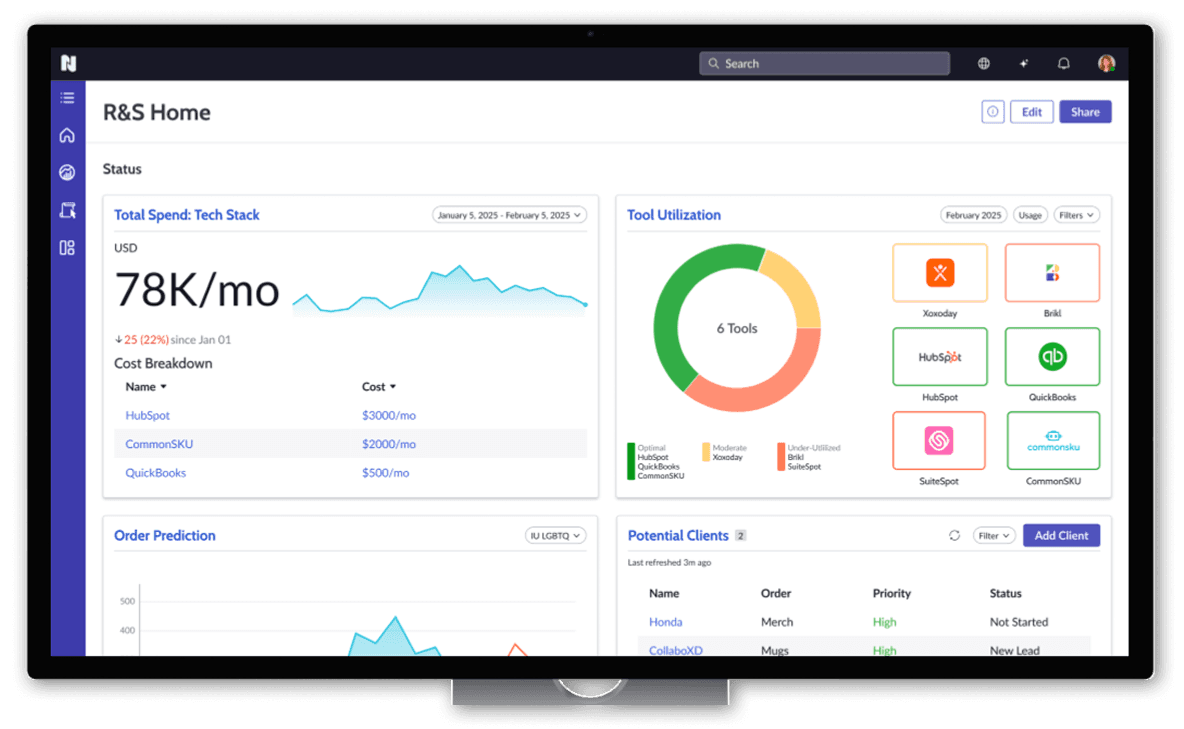
We called it Nexora, an AI-powered platform that predicts feasibility, cost, and ROI of software integrations while also uncovering underutilized tools.
We called it Nexora, an AI-powered platform that predicts feasibility, cost, and ROI of software integrations while also uncovering underutilized tools.
Role: UX Researcher & Designer | Team of 4
Role: UX Researcher & Designer | Team of 4
Timeline: 6 weeks (Jan - Mar 2025)
Timeline: 6 weeks (Jan - Mar 2025)
Type: Client Project (Resource & Supply)
Type: Client Project (Resource & Supply)
Skills/ Tools: UX Research, Problem Framing, System Mapping, Prototyping, Affinity Mapping, Usability Testing, Storytelling, Business Model Canvas
Skills/ Tools: UX Research, Problem Framing, System Mapping, Prototyping, Affinity Mapping, Usability Testing, Storytelling, Business Model Canvas
THE PROBLEM
Today, businesses face serious risks when adopting new tools:
Today, businesses face serious risks when adopting new tools:

Unclear integration feasibility
Unclear integration feasibility

Uncertain costs and timelines
Uncertain costs and timelines

Wasted spend on unused subscriptions
Wasted spend on unused subscriptions

How might we help businesses evaluate ERP integrations, predict ROI, and optimize their current tool usage, so they can make faster, smarter decisions and avoid costly mistakes?
How might we help businesses evaluate ERP integrations, predict ROI, and optimize their current tool usage, so they can make faster, smarter decisions and avoid costly mistakes?
How might we help businesses evaluate ERP integrations, predict ROI, and optimize their current tool usage, so they can make faster, smarter decisions and avoid costly mistakes?
THE SOLUTION
We designed Nexora, a decision-support dashboard that:
We designed Nexora, a decision-support dashboard that:
1
Integration Simulation
Integration Simulation
Predicts feasibility and time/cost of new tool adoption
Predicts feasibility and time/cost of new tool adoption
2
ROI Calculator
ROI Calculator
Estimates value and profitability of an investment
Estimates value and profitability of an investment
3
Utilization Dashboard
Utilization Dashboard
Highlights which tools are driving value and which are underused
Highlights which tools are driving value and which are underused
Research
Ideation
Iteration 1
Iteration 2
ENVIRONMENTAL ANALYSIS
We kicked off with environmental analysis: looked at market data, trends, and competitive gaps. Some findings:
We kicked off with environmental analysis: looked at market data, trends, and competitive gaps. Some findings:
-> Business Environment
Industry Forces
Businesses are rapidly digitizing but integrations remain a challenge
Businesses are rapidly digitizing but integrations remain a challenge
Key Trends
90%
of companies use multiple ERP solutions, yet 70% struggle with integrations.
of companies use multiple ERP solutions, yet 70% struggle with integrations.
Market Forces
75%
of companies say they've lost deals or faced massive delays due to poor system compatibility.
of companies say they've lost deals or faced massive delays due to poor system compatibility.
-> Total Addressable market (TAM)

Market Size
The global ERP software market alone is projected to hit $100 billion by 2026. Yet, companies waste millions annually on failed or inefficient integrations.
The global ERP software market alone is projected to hit $100 billion by 2026. Yet, companies waste millions annually on failed or inefficient integrations.

Growth potential
80% of businesses plan to adopt new software within 2 years but lack integration clarity.
80% of businesses plan to adopt new software within 2 years but lack integration clarity.

Why it matters
Companies waste up to 30% of their software budget on unused or redundant tools.
Companies waste up to 30% of their software budget on unused or redundant tools.
-> Competitor Landscape
Established players
Established players
Companies like SAP, Oracle, and Salesforce focus on their own ecosystems, not integration.
Companies like SAP, Oracle, and Salesforce focus on their own ecosystems, not integration.
Up-and-Comers
Up-and-Comers
Similar integration platforms exist but fail to provide ROI analysis or strategic insights.
Similar integration platforms exist but fail to provide ROI analysis or strategic insights.
Where they fall short
Where they fall short
No solution offers comprehensive feasibility analysis, cost projections, and AI-powered recommendations.
No solution offers comprehensive feasibility analysis, cost projections, and AI-powered recommendations.
WHAT I LEARNED
Problem framing matters: refining the HMW and problem statements early made every subsequent decision clearer.
Problem framing matters: refining the HMW and problem statements early made every subsequent decision clearer.
Fail fast is real: our first prototype “failed”, but the failure was the most valuable feedback we got. It forced us to simplify and prioritize.
Fail fast is real: our first prototype “failed”, but the failure was the most valuable feedback we got. It forced us to simplify and prioritize.
Design for trust: in B2B enterprise tools, justifying AI outputs (showing inputs, assumptions, confidence) is as important as the prediction itself.
Design for trust: in B2B enterprise tools, justifying AI outputs (showing inputs, assumptions, confidence) is as important as the prediction itself.
Balance creativity & feasibility: ideation produced many exciting directions, but client constraints and technical feasibility guided our choice, the best idea is the one you can validate and deploy.
Balance creativity & feasibility: ideation produced many exciting directions, but client constraints and technical feasibility guided our choice, the best idea is the one you can validate and deploy.
⚡ Takeaway: This project was a chance to combine UX design, business innovation, and storytelling to tackle a real enterprise challenge, showing me the power of designing not just for usability, but for strategic decision-making.
⚡ Takeaway: This project was a chance to combine UX design, business innovation, and storytelling to tackle a real enterprise challenge, showing me the power of designing not just for usability, but for strategic decision-making.
NEXT STEPS
Connect to real ERP/CRM APIs to ground simulations in live data.
Connect to real ERP/CRM APIs to ground simulations in live data.
Expand AI models and add confidence calibration from more pilot data.
Expand AI models and add confidence calibration from more pilot data.
Design a tiered pricing model and a pilot program (3–6 months) with Resource & Supply.
Design a tiered pricing model and a pilot program (3–6 months) with Resource & Supply.
Build an onboarding flow that helps teams import tool inventories and license counts automatically.
Build an onboarding flow that helps teams import tool inventories and license counts automatically.